 Add to Chrome
 Add to Firefox
 Add to Edge
Generating Logically Consistent Synthetic Supply Chain Data with LLM-Driven Knowledge Graph Reasoning
May 26, 2026
Synthetic data offers a promising solution to two persistent barriers in supply chain analytics: data scarcity and data privacy. However, for synthetic data to support operational simulation and decision-making, it must do more than reproduce the statistical distributions of real records, and also preserve the \emph{operational logic} that governs supply chain processes, including the temporal orderings, mathematical dependencies, hierarchical taxonomies, and conditional rules that make a record operationally plausible. We consider this logic as the ``physics'' of supply chain data. Existing tabular generative models are primarily optimized for distributional fidelity and downstream predictive utility, and therefore often generate records that appear statistically realistic but violate fundamental operational constraints. This paper introduces \textbf{\textit{TabKG}}, a knowledge-graph-guided framework for logically consistent synthetic supply chain tabular data generation. TabKG constructs a \textbf{\textit{Column Relationship Knowledge Graph (CR-KG)}} to represent data operational dependencies. It uses a multi-LLM ensemble with majority voting to propose candidate relationships from column metadata, validates these relationships against real data to remove hallucinated or unsupported edges, and then uses the validated CR-KG to guide generation. Specifically, TabKG compresses the original table into independent columns, generates these columns using a latent diffusion model, and deterministically reconstructs dependent columns according to the validated relationships, enforcing logical consistency by construction with respect to the discovered operational rules.

EmoDistill: Offline Emotion Skill Distillation for Language Model Agents in Adversarial Negotiation
May 26, 2026Post-trained LLMs are often optimized to align responses with human preferences, making them safe, polite, and conversationally appropriate. In adversarial negotiation, however, this alignment can become a vulnerability: emotionally framed language may steer agents toward the counterparty's interests. Using GoEmotions-based affective prompting, we show that emotion substantially shifts negotiation outcomes, suggesting that emotion is a strategic action channel rather than a surface style. Thus, we introduce \textbf{EmoDistill}, an offline framework for distilling emotional negotiation skills into language model agents. EmoDistill decomposes emotional strategy into emotion selection and emotion expression: an Implicit Q-Learning (IQL) selector learns \emph{which} emotion to express, while a Low-Rank Adaptation (LoRA)-based policy learns \emph{how} to express it through Supervised Fine-Tuning (SFT) and Judge Policy Optimization (JPO). Across four emotion-sensitive, high-stakes negotiation domains, SLM policies trained under the EmoDistill framework achieve the highest utility, outperforming vanilla SLM/LLM baselines and IQL-only emotion selection. Ablations show that emotion conditioning is essential, and transfer studies demonstrate generalization across domains, unseen counterparties, and trained-vs-trained tournaments. Overall, EmoDistill learns skills from offline agent-to-agent interactions, avoiding costly online negotiation during training.
Helicase: Uncertainty-Guided Supply Chain Knowledge Graph Construction with Autonomous Multi-Agent LLMs
May 26, 2026LLM-based multi-agent systems have been widely adopted for knowledge retrieval and report generation, synthesizing known information through web search and textual reasoning. However, many critical information tasks in supply chains are not simple one-shot queries: they are structural inference problems requiring multi-hop reasoning across complex, fragmented web resources. Questions such as \textit{``Which Tesla components use lithium from Australian mines?''} have no answer in any single document; answers must be computationally synthesized through the autonomous construction and analysis of dynamic knowledge graphs assembled from fragmented, heterogeneous sources. Moreover, such discovery processes must be uncertainty-aware: decisions depend not only on answers but on calibrated confidence in their reliability, traceable to source quality and reasoning consistency. To address this capability gap, we propose \textit{Helicase}, an autonomous multi-agent LLM system for uncertainty-guided supply chain knowledge graph construction. \textit{Helicase} decomposes high-level supply-chain queries into executable investigation plans, coordinates specialized web-search, reasoning, and coding agents through iterative verification loops, and incrementally constructs query-specific supply chain knowledge graphs with per-fact uncertainty annotations. Its three-layer uncertainty framework tracks uncertainty at the action, trajectory, and memory layers, enabling both structural inference and calibrated confidence assessment. To evaluate autonomous reasoning across the full complexity spectrum, we introduce SCQA (Supply Chain Query Assessment), a benchmark of 80 supply chain queries organized into four quadrants spanning single-hop to multi-hop inference under both high and low data visibility.
VeriTrace: Evolving Mental Models for Deep Research Agents
May 25, 2026Deep research agents face vast, interdependent, and pervasively uncertain information. Existing systems explore what evolving intermediate representations should look like, but leave their evolution to the LLM's implicit reasoning. Without explicit regulation, the intermediate layer is easily contaminated by mixed-quality information and propagates errors along its dependencies, so model scale often ends up substituting for absent regulation. We argue that an agent's mental model should instead evolve through explicit feedback that continuously aligns task understanding with reality, and identify three regulatory loops: interpretive update, deviation feedback, and schema revision. We realise this in VeriTrace, a cognitive-graph framework that explicitly implements the three loops. Using matched Qwen3.5-27B backbones, VeriTrace improves over the strongest matched baseline by 4.22 pp on DeepResearch Bench (DRB) Insight (1.49 pp Overall) and by 5.9 pp Overall win rate on DeepConsult. With Config-DeepSeek, it achieves the strongest reproducible open-source result on DRB.
Self-Improving Tabular Language Models via Iterative Group Alignment
Apr 21, 2026While language models have been adapted for tabular data generation, two fundamental limitations remain: (1) static fine-tuning produces models that cannot learn from their own generated samples and adapt to self-correct, and (2) autoregressive objectives preserve local token coherence but neglect global statistical properties, degrading tabular quality. Reinforcement learning offers a potential solution but requires designing reward functions that balance competing objectives -- impractical for tabular data. To fill the gap, we introduce TabGRAA (Tabular Group-Relative Advantage Alignment), the first self-improving framework for tabular data generation via automated feedback. At each iteration, TabGRAA uses an \emph{automated quality signal} -- such as a two-sample distinguishability classifier or a distance-based reward -- to partition newly generated samples into high- and low-quality groups, then optimizes a group-relative advantage objective that reinforces realistic patterns while penalizing artifacts. The specific signal is a modular choice rather than a fixed component of the framework. This establishes a virtuous feedback cycle, where the quality signal is re-computed against newly \emph{generated synthetic} samples at each round; the language model is only fine-tuned on these self-generated signals, so no additional real record is exposed during alignment, mitigating data-leakage risk beyond the initial supervised fine-tuning. Experiments show TabGRAA outperforms existing methods in fidelity, utility, and privacy, while matching or exceeding diffusion-based synthesizers, advancing tabular synthesis from static statistical replication to dynamic, self-improving generation.
Structural Consequences of Policy-Based Interventions on the Global Supply Chain Network
Apr 14, 2026As global political tensions rise and the anticipation of additional tariffs from the United States on international trade increases, the issues of economic independence and supply chain resilience become more prominent. The importance of supply chain resilience has been further underscored by disruptions caused by the COVID-19 pandemic and the ongoing war in Ukraine. In light of these challenges, ranging from geopolitical instability to product supply uncertainties, governments are increasingly focused on adopting new trade policies. This study explores the impact of several of these policies on the global electric vehicle (EV) supply chain network, with a particular focus on their effects on country clusters and the broader structure of international trade. Specifically, we analyse three key policies: Country Plus One, Friendshoring, and Reshoring. Our findings show that Friendshoring, contrary to expectations, leads to greater globalisation by increasing the number of supply links across friendly countries, potentially raising transaction costs. The Country Plus One policy similarly enhances network density through redundant links, while the Reshoring policy creates challenges in the EV sector due to the high number of irreplaceable products. Additionally, the effects of these policies vary across industries; for instance, mining goods being less affected in Country Plus One than the Friendshoring policy.
Automating Supply Chain Disruption Monitoring via an Agentic AI Approach
Jan 14, 2026Modern supply chains are increasingly exposed to disruptions from geopolitical events, demand shocks, trade restrictions, to natural disasters. While many of these disruptions originate deep in the supply network, most companies still lack visibility beyond Tier-1 suppliers, leaving upstream vulnerabilities undetected until the impact cascades downstream. To overcome this blind-spot and move from reactive recovery to proactive resilience, we introduce a minimally supervised agentic AI framework that autonomously monitors, analyses, and responds to disruptions across extended supply networks. The architecture comprises seven specialised agents powered by large language models and deterministic tools that jointly detect disruption signals from unstructured news, map them to multi-tier supplier networks, evaluate exposure based on network structure, and recommend mitigations such as alternative sourcing options. \rev{We evaluate the framework across 30 synthesised scenarios covering three automotive manufacturers and five disruption classes. The system achieves high accuracy across core tasks, with F1 scores between 0.962 and 0.991, and performs full end-to-end analyses in a mean of 3.83 minutes at a cost of \$0.0836 per disruption. Relative to industry benchmarks of multi-day, analyst-driven assessments, this represents a reduction of more than three orders of magnitude in response time. A real-world case study of the 2022 Russia-Ukraine conflict further demonstrates operational applicability. This work establishes a foundational step toward building resilient, proactive, and autonomous supply chains capable of managing disruptions across deep-tier networks.
EQ-Negotiator: Dynamic Emotional Personas Empower Small Language Models for Edge-Deployable Credit Negotiation
Nov 05, 2025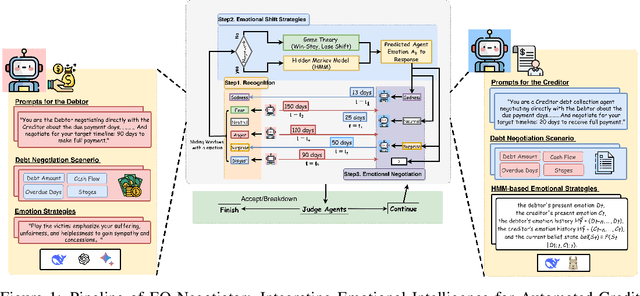
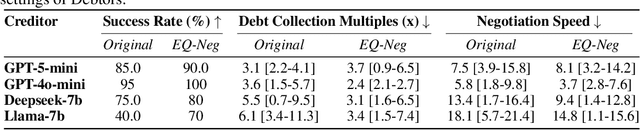
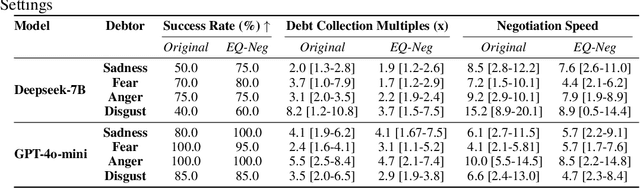
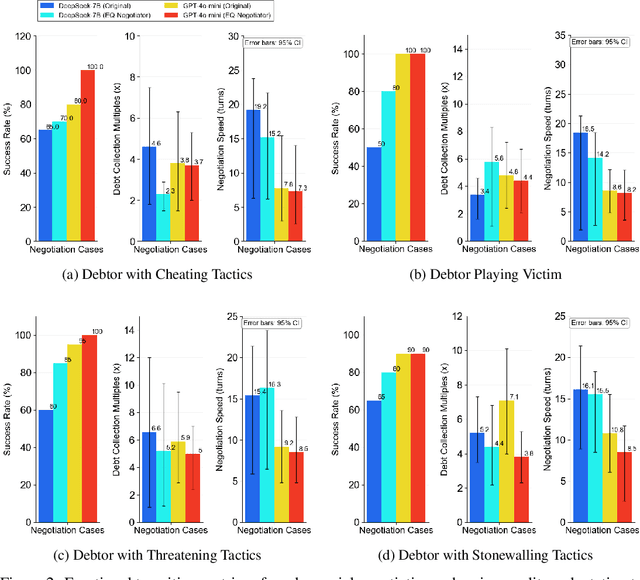
The deployment of large language models (LLMs) in automated negotiation has set a high performance benchmark, but their computational cost and data privacy requirements render them unsuitable for many privacy-sensitive, on-device applications such as mobile assistants, embodied AI agents or private client interactions. While small language models (SLMs) offer a practical alternative, they suffer from a significant performance gap compared to LLMs in playing emotionally charged complex personas, especially for credit negotiation. This paper introduces EQ-Negotiator, a novel framework that bridges this capability gap using emotional personas. Its core is a reasoning system that integrates game theory with a Hidden Markov Model(HMM) to learn and track debtor emotional states online, without pre-training. This allows EQ-Negotiator to equip SLMs with the strategic intelligence to counter manipulation while de-escalating conflict and upholding ethical standards. Through extensive agent-to-agent simulations across diverse credit negotiation scenarios, including adversarial debtor strategies like cheating, threatening, and playing the victim, we show that a 7B parameter language model with EQ-Negotiator achieves better debt recovery and negotiation efficiency than baseline LLMs more than 10 times its size. This work advances persona modeling from descriptive character profiles to dynamic emotional architectures that operate within privacy constraints. Besides, this paper establishes that strategic emotional intelligence, not raw model scale, is the critical factor for success in automated negotiation, paving the way for effective, ethical, and privacy-preserving AI negotiators that can operate on the edge.
EvoEmo: Towards Evolved Emotional Policies for LLM Agents in Multi-Turn Negotiation
Sep 04, 2025Recent research on Chain-of-Thought (CoT) reasoning in Large Language Models (LLMs) has demonstrated that agents can engage in \textit{complex}, \textit{multi-turn} negotiations, opening new avenues for agentic AI. However, existing LLM agents largely overlook the functional role of emotions in such negotiations, instead generating passive, preference-driven emotional responses that make them vulnerable to manipulation and strategic exploitation by adversarial counterparts. To address this gap, we present EvoEmo, an evolutionary reinforcement learning framework that optimizes dynamic emotional expression in negotiations. EvoEmo models emotional state transitions as a Markov Decision Process and employs population-based genetic optimization to evolve high-reward emotion policies across diverse negotiation scenarios. We further propose an evaluation framework with two baselines -- vanilla strategies and fixed-emotion strategies -- for benchmarking emotion-aware negotiation. Extensive experiments and ablation studies show that EvoEmo consistently outperforms both baselines, achieving higher success rates, higher efficiency, and increased buyer savings. This findings highlight the importance of adaptive emotional expression in enabling more effective LLM agents for multi-turn negotiation.
Redirection for Erasing Memory (REM): Towards a universal unlearning method for corrupted data
May 23, 2025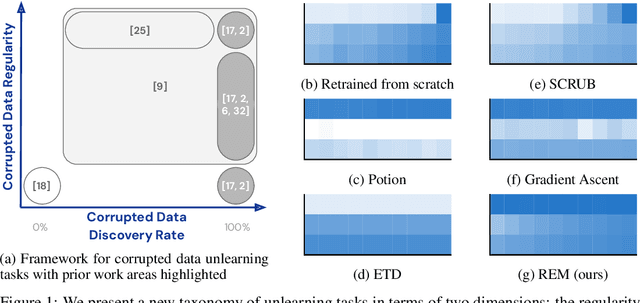
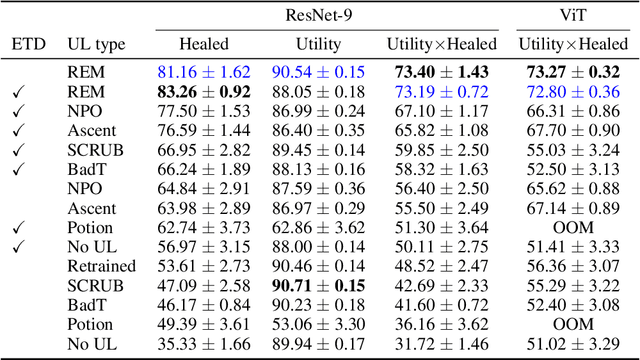
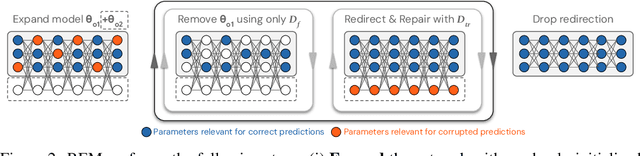
Machine unlearning is studied for a multitude of tasks, but specialization of unlearning methods to particular tasks has made their systematic comparison challenging. To address this issue, we propose a conceptual space to characterize diverse corrupted data unlearning tasks in vision classifiers. This space is described by two dimensions, the discovery rate (the fraction of the corrupted data that are known at unlearning time) and the statistical regularity of the corrupted data (from random exemplars to shared concepts). Methods proposed previously have been targeted at portions of this space and-we show-fail predictably outside these regions. We propose a novel method, Redirection for Erasing Memory (REM), whose key feature is that corrupted data are redirected to dedicated neurons introduced at unlearning time and then discarded or deactivated to suppress the influence of corrupted data. REM performs strongly across the space of tasks, in contrast to prior SOTA methods that fail outside the regions for which they were designed.